

 228
228
 0
0
How quickly can a GNSS-enabled device report its first usable position after power-up?
The answer is often expressed as Time to First Fix, or TTFF. However, a single TTFF value does not describe every startup situation. A receiver starting without valid navigation data performs a different task from one that has retained recent time, position and satellite information.
For engineers and B2B buyers, understanding cold, warm and hot starts is essential when comparing GNSS modules, designing a battery-powered tracker or preparing a realistic sample-validation plan.
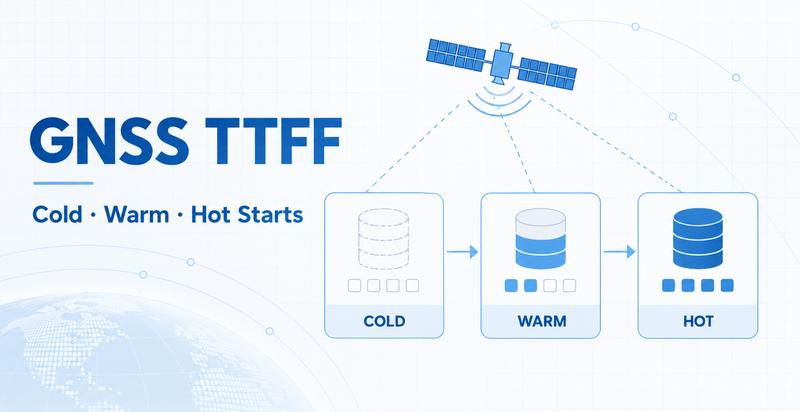
TTFF is the elapsed time between a defined receiver startup event and the first valid position solution.
For the figure to be meaningful, the test should identify:
- Startup state
- Signal level and sky visibility
- Antenna configuration
- Whether assistance data is available
- Receiver firmware and configuration
- Test temperature
- Stationary or moving operation
- Criteria used to identify a valid fix
TTFF is especially important in products that wake only when a position report is required. The longer the receiver remains in acquisition mode, the longer the user waits and the more energy the device may consume before returning to sleep.
Typical examples include asset trackers, portable terminals, vehicle devices and battery-powered IoT equipment.
GNSS receivers generally distinguish startup modes according to the valid information available when the receiver restarts.
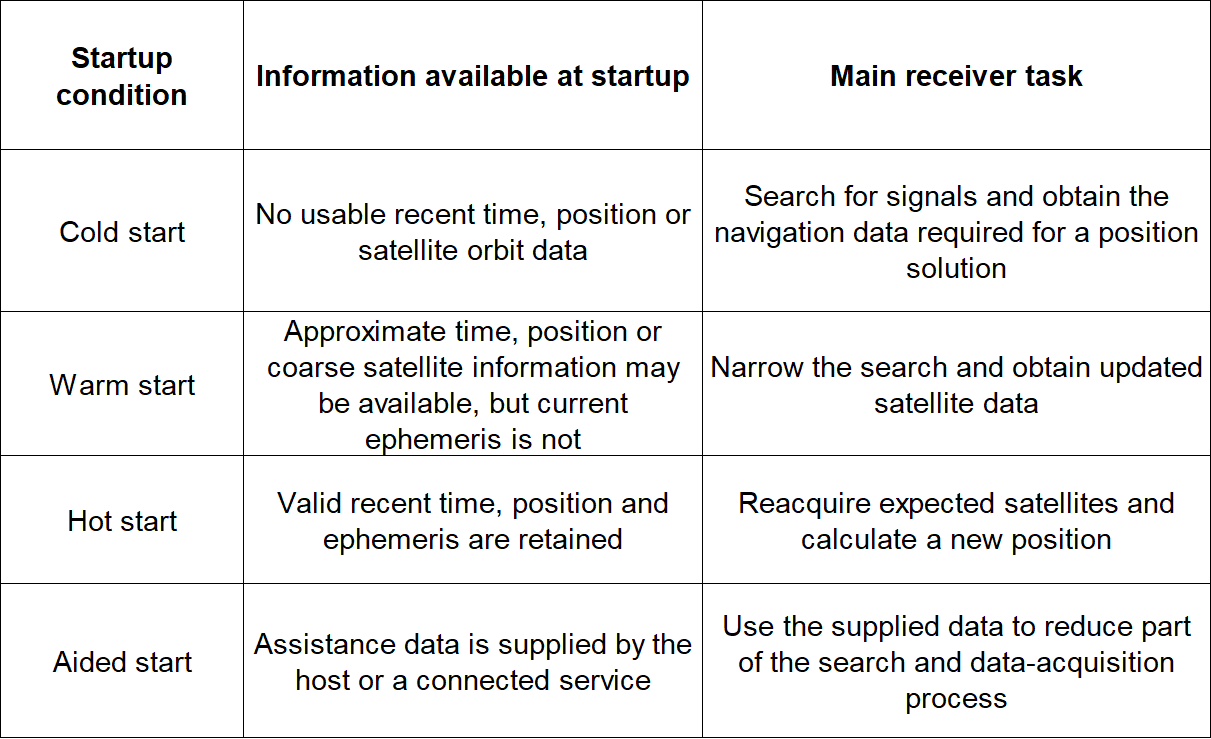 An aided start is not necessarily a completely separate startup category. Assistance may be applied to a receiver that would otherwise perform a cold or warm start.
The exact definition of each state can vary between receiver platforms. When comparing modules, use the terminology and test conditions stated in the corresponding technical documentation.
A short hot-start value should not be interpreted as the expected result for first power-up, operation after a long storage period or a restart after all backup data has been lost.
Published TTFF values are normally measured under defined conditions. Results inside a finished device may differ for several reasons.
Briefly switching off the main supply may still preserve critical navigation data if the receiver has a backup domain, capacitor or backup power source. That test may therefore produce a hot start rather than a cold start.
Conversely, a device without suitable data retention may perform a cold start every time its main power is removed.
Buildings, vehicle roofs, coated glass, foliage, metal enclosures and unsuitable installation angles can reduce the number or quality of visible satellite signals.
The receiver may detect some satellites but still require more time to obtain enough valid data for a position solution.
Antenna size, frequency support, orientation, ground plane, cable loss and placement all affect received signal quality.
Testing a module on an open evaluation board does not replace validation with the intended antenna, PCB and enclosure. For integration guidance, see the GNSS Antenna Placement and PCB Layout Guide.
Switching regulators, displays, processors, motors, cellular transmitters, Wi-Fi and Bluetooth circuits can change the receiver's RF environment.
GNSS startup should therefore be tested while the other functions of the finished device are operating in representative modes.
An A-GNSS-capable receiver cannot benefit from assistance data unless the required data is available, current and delivered correctly.
Network connection time, server response, host processing and assistance-data age can all affect the complete time from device wake-up to a usable location report.
The GNSS engine may already have a valid position while the host is still starting, opening its communication port or parsing output messages.
UART baud rate does not directly determine how quickly the GNSS engine calculates a fix, but interface initialization and host software can add delay before the application recognizes that fix. See UART vs. RS-232 vs. USB for GNSS Receivers.
Assisted GNSS can provide information such as:
- Approximate time
- Approximate position
- Satellite orbit data
- Satellite availability information
This information can reduce the amount of searching or navigation-data collection required after startup.
A-GNSS should not be confused with RTK or another correction service intended to improve final positioning accuracy. Its primary role in this context is to support signal acquisition and reduce startup time.
Before selecting an A-GNSS solution, confirm:
- Which assistance method the module supports
- Which satellite systems are covered
- Whether the host needs an internet connection
- How assistance data is downloaded and transferred
- How long the data remains usable
- Required host memory and firmware
- What happens when the network is unavailable
- Whether any third-party service or operating cost applies
The complete assisted-start time should include both data delivery and GNSS acquisition, not only the receiver's internal processing time.
Some GNSS designs use a backup supply, backup domain or onboard energy-storage component to retain the real-time clock and critical navigation data while the main supply is off.
This can support a warm or hot start when the receiver is restarted within the applicable retention period.
Engineers should confirm:
- Whether the selected model has a backup-supply input
- Backup-voltage range
- Backup current
- Data retained in backup mode
- Expected retention time
- Charging requirements for any onboard capacitor
- Behavior after complete battery depletion
- Reset commands that clear retained navigation data
An onboard capacitor does not guarantee a hot start after an unlimited power-off period. Retention behavior must be verified for the selected module and power architecture.
Several GNSS parameters describe different parts of receiver performance.
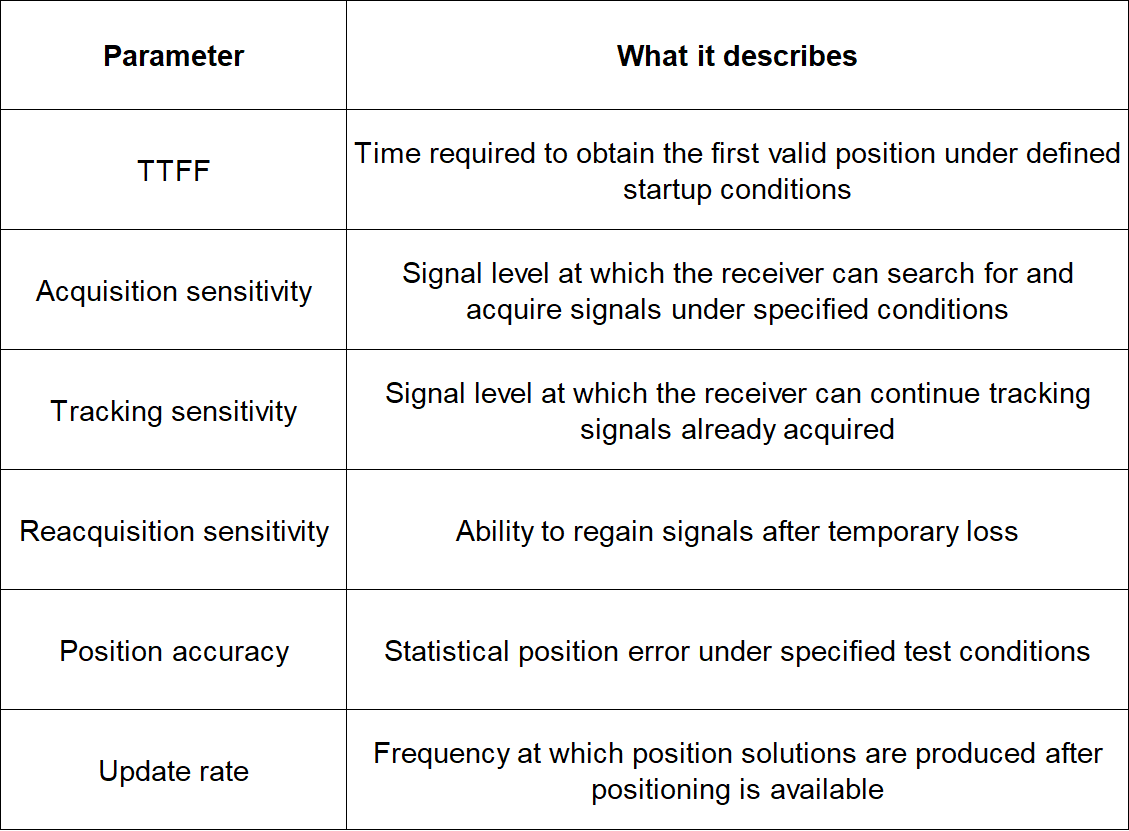
Tracking sensitivity is often expressed as a more negative value than cold-start sensitivity. It should not be used alone to predict cold-start performance.
Similarly, a higher update rate does not automatically shorten TTFF. Update rate describes how often the receiver produces new solutions after it is operating.
WEILA publishes startup and A-GNSS information for several GNSS products.
The WKG0254T05Y01 product page lists A-GNSS support, a cold-start time of less than 32 seconds and a hot-start time of less than one second.
The WKG0184T06Y01 product page lists A-GNSS support, a cold-start time of less than 23 seconds and a hot-start time of less than one second.
These figures are model-level specifications and should not be treated as guaranteed results for every finished device. The two modules also have different form factors, receiver platforms, antenna structures and configurations, so one TTFF number should not be used as the only selection criterion.
Before design approval, request the current product documentation and validate the selected sample under the project’s real operating conditions.
Explore the WEILA GNSS and BeiDou module range for available integration formats.
A practical validation plan should cover the operating states the finished product will actually encounter.
Examples may include:
- First power-up after manufacturing
- Startup after long-term storage
- Daily wake-up for one position report
- Restart after a short sleep interval
- Recovery after temporary signal loss
- Startup after the device has moved to another region
For a cold-start test, use the receiver's documented command or procedure to clear the relevant navigation data.
A short power cycle is not sufficient evidence of a cold start if backup data is still retained.
For warm and hot-start tests, define the power-off interval, retained data and backup-power conditions.
Begin with an open-sky baseline and then repeat the test in representative environments, such as:
- Inside the intended enclosure
- Inside a vehicle
- Near buildings
- Under partial obstruction
- With cellular, Wi-Fi or Bluetooth radios active
- At the required operating temperatures
Record the time from the agreed startup event until the module reports a valid fix according to its documented output.
If NMEA messages are used, specify the exact message and status field that the host application will use. Do not stop the timer merely because serial data has appeared.
One successful startup does not characterize the product.
Use a predefined number of repetitions and report the median, percentile and worst observed result rather than only the fastest attempt.
Record:
- Time to valid fix
- Satellite count
- Available signal-quality information
- Fix type
- GNSS acquisition current
- Total device current
- Assistance-data delivery time
- Host recognition time
- Radio and peripheral operating states
- Test location and environmental conditions
This separates receiver acquisition time from network, host-software and system-level delays.
Provide the following information to the supplier:
- Application and target market
- Expected startup frequency
- Maximum acceptable time to first fix
- Cold, warm or hot-start requirement
- Whether network assistance is available
- Required satellite systems and frequency bands
- Antenna type and installation position
- Host interface and logic voltage
- Main and backup power architecture
- Sleep and wake-up cycle
- Enclosure material
- Operating environment
- Other wireless transmitters in the device
- Required test conditions
- Prototype and expected production quantities
A complete project description helps the engineering team recommend a suitable GNSS module and prepare a sample configuration that can be tested meaningfully.
GNSS TTFF is not a universal number. Cold, warm, hot and aided starts begin with different information, so they require different acquisition processes.
The most reliable selection method is to confirm the startup definition, assistance method, backup-power behavior, antenna design and published test conditions—and then validate the complete product under its real operating cycle.
Contact WEILA with your application, startup requirement, antenna arrangement, interface, power design and test environment to discuss an appropriate GNSS module or customized PCBA solution.
TTFF means Time to First Fix. It measures how long the receiver takes to provide its first valid position after a defined startup event.
A hot start can use valid recent time, position and satellite orbit information. A cold start must perform a broader signal search and obtain the navigation data required for positioning.
No. A backup supply, capacitor or retained data may allow the receiver to perform a warm or hot start. The result depends on the module and power design.
A-GNSS primarily helps the receiver acquire signals and obtain a first fix more quickly. Final positioning accuracy still depends on the receiver, antenna, satellite signals, environment and any applicable correction method.
The startup state, antenna, sky visibility, interference, assistance data, temperature, movement and valid-fix criteria may differ from the published test conditions.
No. Tracking sensitivity describes the ability to maintain already acquired signals. Cold-start acquisition and TTFF should be evaluated separately.
Compare figures only when startup definitions, signal conditions, antenna setup, assistance status and valid-fix criteria are equivalent.
Company Address
Floor 11, Block A, Building 9, Baoneng Science and Technology Park, Qingxiang Road, Longhua District, Shenzhen
Tel: +86 755-8329018
Business Hours
Monday–Friday
9:00 AM–6:00 PM (GMT+8)



+8613247518427



0755-8329018

13602688458

 Previous
 List
List