

 243
243
 0
0
GNSS modules are widely used in vehicle tracking, asset management, drones, industrial equipment, smart agriculture and IoT devices. When selecting a GNSS module, buyers often compare the supported satellite systems, positioning accuracy, sensitivity, power consumption and interface options.
Another important factor is whether the module uses a single frequency band or dual frequency bands.
A single-band GNSS module receives positioning signals from one main frequency band, such as GPS L1, BeiDou B1, GLONASS L1 or Galileo E1.
Single-band modules are widely used because they normally offer a good balance between positioning performance, product cost, power consumption and integration complexity.
They are suitable for applications such as:
- Vehicle and fleet tracking
- Asset tracking devices
- Smart meters
- Shared mobility equipment
- Standard IoT positioning
- Navigation terminals
- Timing and synchronization equipment
For applications operating mainly in open-sky environments and requiring standard meter-level positioning, a single-band module is often sufficient.
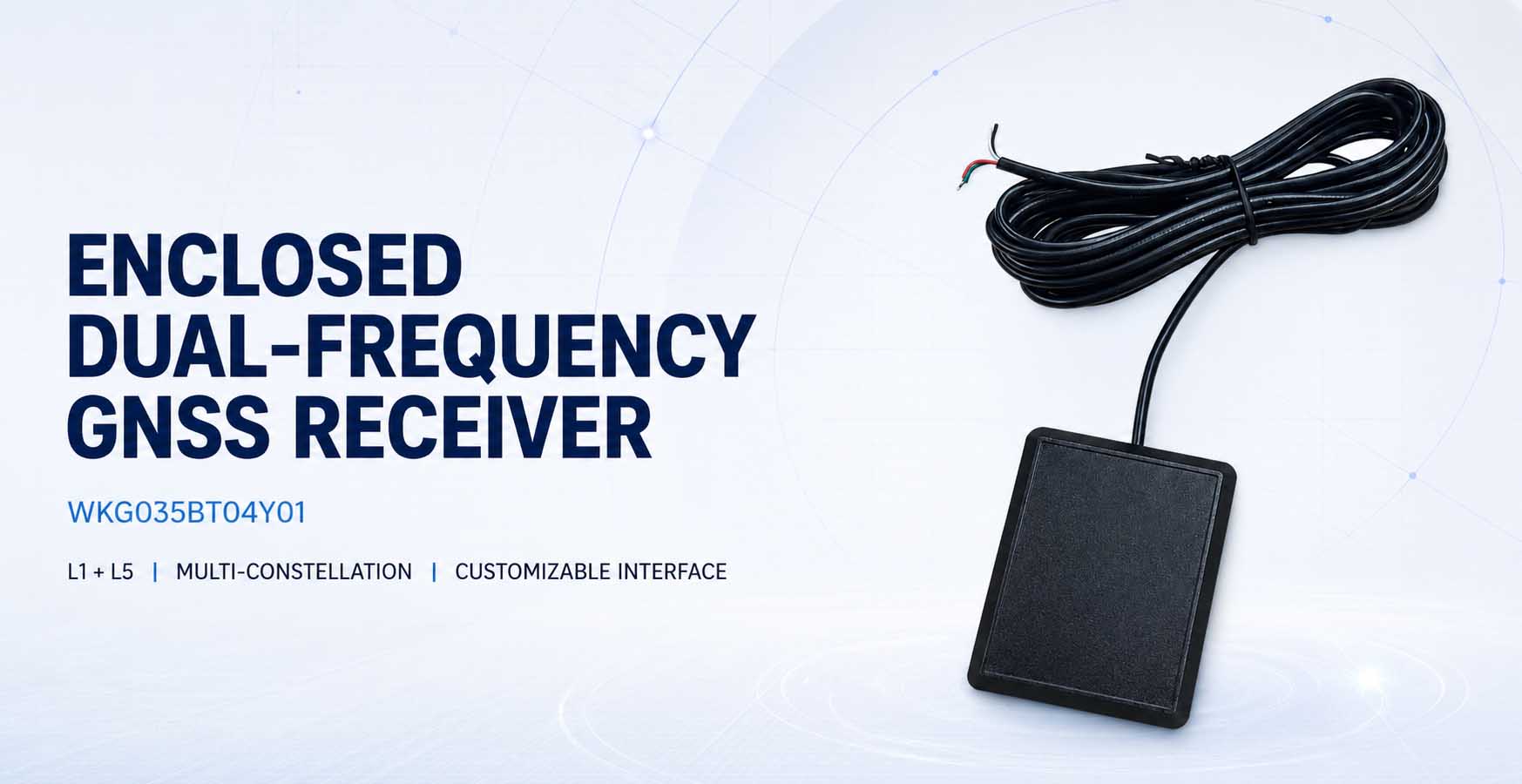
A dual-band GNSS module receives signals from two different frequency bands, such as L1 and L5 or corresponding BeiDou and Galileo frequency combinations.
By using signals from two bands, the receiver can better compensate for certain signal errors and improve positioning reliability in difficult environments. Actual performance still depends on the antenna, satellite visibility, receiver algorithm and surrounding environment.
Dual-band modules are commonly used in:
- Drones and unmanned systems
- Robotics
- Precision navigation
- Agricultural machinery
- Surveying and mapping equipment
- High-performance vehicle positioning
- Equipment operating in urban or obstructed environments
Positioning performance
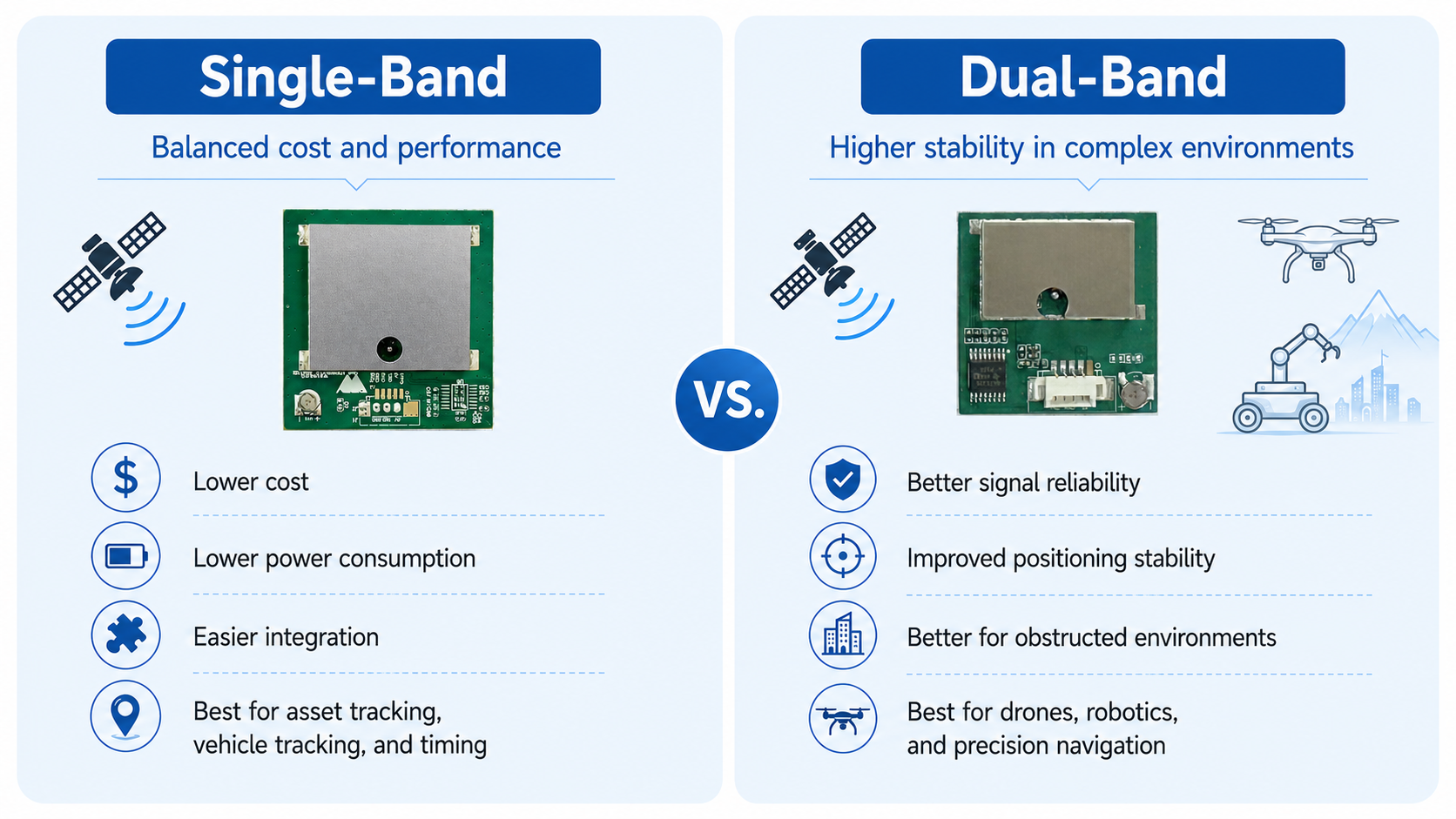
Single-band modules are suitable for standard positioning requirements. Dual-band modules generally provide stronger positioning stability and better performance in complex environments.
Cost
Single-band modules normally have a lower total system cost. Dual-band solutions may require a higher-cost receiver, antenna and PCB design.
Power consumption
Single-band modules are often preferred in battery-powered devices. However, actual power consumption depends on the chipset, working mode, update rate and firmware configuration.
Antenna design
A single-band module can use a relatively simple antenna solution. A dual-band module requires an antenna that properly supports both frequency bands.
Application environment
For open outdoor environments, single-band positioning may be enough. For urban areas, reflective environments or applications requiring greater positioning reliability, dual-band GNSS may be more suitable.
A single-band GNSS module may be the better choice when:
- Standard positioning accuracy is sufficient
- Cost and power consumption are important
- The device mainly operates in open environments
- The product requires a compact and simple design
A dual-band GNSS module may be more suitable when:
- The application requires higher positioning stability
- The equipment operates near buildings or in obstructed environments
- Positioning performance is more important than minimum cost
- The project involves drones, robotics or precision equipment
Frequency band is only one part of GNSS module selection. Buyers should also consider:
- Supported satellite constellations
- Positioning accuracy
- Tracking sensitivity
- Time to first fix
- Update rate
- Power consumption
- Antenna type
- Communication interface
- Module dimensions
- Operating temperature
- Firmware and technical support
WEILA provides multiple GNSS module options, including single-system, multi-constellation, single-band and dual-band solutions.
We can also support:
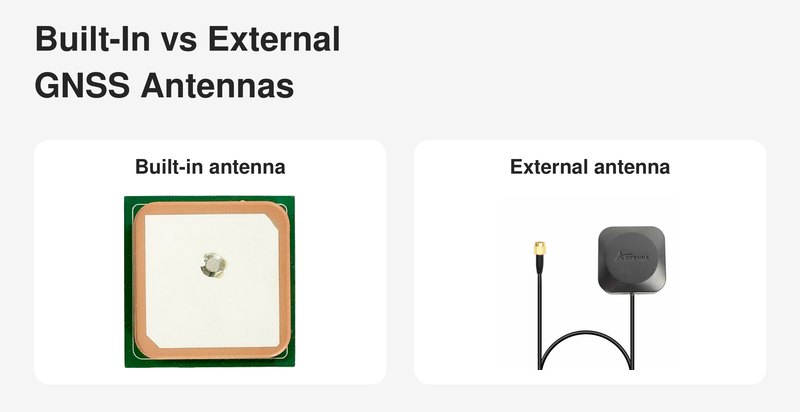
- Ceramic antenna and external antenna options
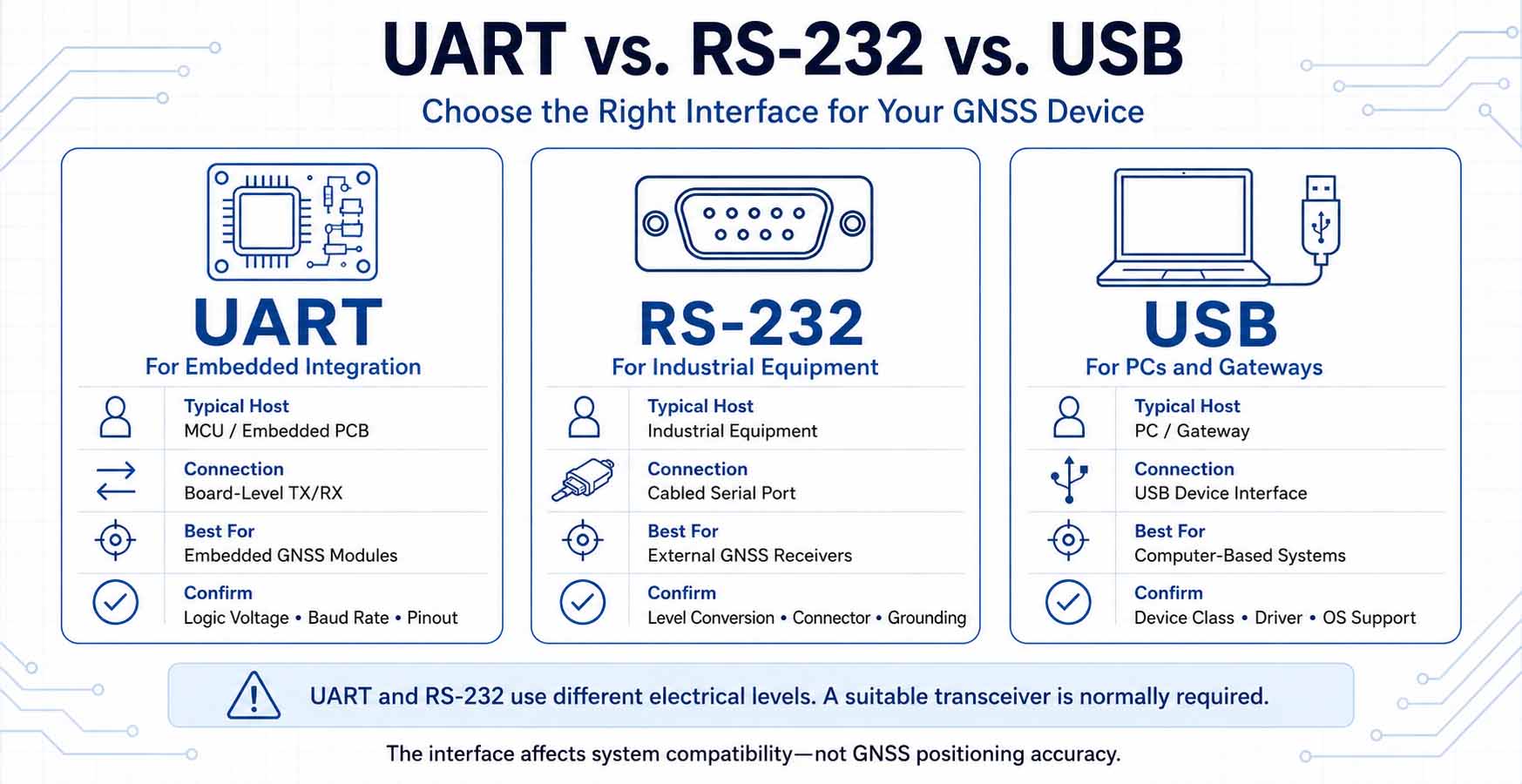
- UART, USB and RS232 interfaces
- Customized PCBA design
- Firmware and protocol adaptation
- Vehicle, asset tracking and industrial positioning applications
- Technical documentation and integration support
The most suitable GNSS solution should be selected according to the required accuracy, product environment, antenna design, power consumption and target cost.
Contact WEILA and share your application, required interface, positioning accuracy and operating environment. Our team will help evaluate the appropriate GNSS module for your project.
Company Address
Floor 11, Block A, Building 9, Baoneng Science and Technology Park, Qingxiang Road, Longhua District, Shenzhen
Tel: +86 755-8329018
Business Hours
Monday–Friday
9:00 AM–6:00 PM (GMT+8)



+8613247518427



0755-8329018

13602688458

 NO
NO List
List