

 215
215
 0
0
Selecting a GNSS receiver involves more than comparing supported constellations, frequency bands and positioning specifications. The receiver must also communicate reliably with the host device.
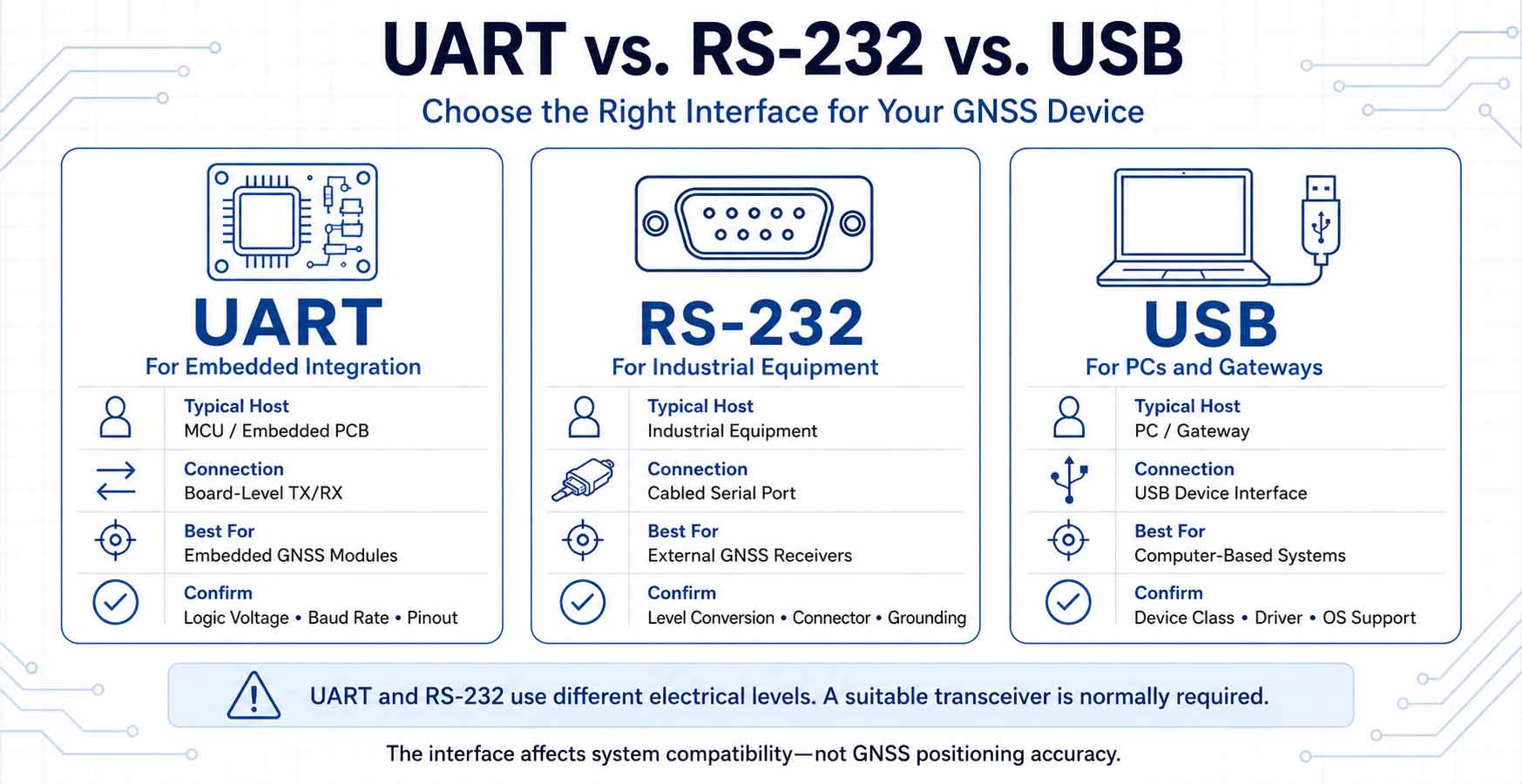
UART, RS-232 and USB are commonly considered for GNSS products, but they serve different system architectures. Choosing the wrong interface can result in incompatible voltage levels, additional hardware, driver problems or unsuitable cable arrangements.
This guide explains how engineers and B2B buyers can select an appropriate GNSS connection for an embedded device, industrial terminal or external receiver.
Before selecting an interface, identify how the GNSS receiver will connect to the finished product.
Confirm:
- Host processor or equipment type
- Available communication ports
- Host logic voltage
- Required cable length
- Connector and pin definition
- Required GNSS data format
- Baud rate and position update rate
- Operating system and driver requirements
- Power supply arrangement
- Installation and electromagnetic environment
The interface should be selected as part of the complete system design rather than after the GNSS module has already been ordered.
UART is commonly used when a GNSS module is installed directly on the host PCB or connected to a nearby microcontroller.
A typical connection includes transmit, receive and ground signals. Depending on the project, additional signals such as reset, standby or one-pulse-per-second output may also be required.
UART can provide a straightforward embedded connection, but several details must be confirmed:
- Logic voltage, such as 1.8 V, 3.3 V or another specified level
- Default and supported baud rates
- NMEA message configuration
- Position update rate
- RX and TX pin assignment
- Ground connection
- Cable or PCB trace length
- Electromagnetic interference conditions
Logic-level UART should not be connected directly to an RS-232 port. The two interfaces use different electrical signalling and normally require a suitable transceiver between them.
UART is usually a practical choice when the receiver is located inside the same device as the host controller.
RS-232 is often used with industrial equipment, legacy systems, data loggers and external GNSS receivers.
Although RS-232 carries serial data, it is electrically different from the UART pins found on most GNSS modules and microcontrollers. A level-conversion circuit is required when converting between logic-level UART and RS-232.
RS-232 may be appropriate when:
- The host equipment already provides an RS-232 port
- The GNSS receiver is installed outside the main device
- A defined external connector is required
- The customer needs compatibility with existing industrial equipment
- A cabled receiver format is preferred
Before ordering, confirm the connector, pin definition, cable length, baud rate, power input and grounding arrangement. A familiar connector shape does not guarantee that two products use the same pinout.
Cable performance should be evaluated under the actual data rate, cable type, grounding and electrical-noise conditions. RS-232 electrical characteristics are explained further in Texas Instruments’ RS-232 FAQ.
USB can be convenient when a GNSS receiver connects to a computer, industrial PC or gateway with a USB host port.
However, “USB interface” alone is not a complete specification. The supplier and customer should confirm:
- USB device class
- Whether the receiver appears as a virtual COM port
- Driver requirements
- Supported operating systems
- Connector type
- Cable length
- Power consumption
- Enumeration and reconnection behaviour
A GNSS module with UART output cannot normally be converted into a USB receiver with a passive cable. An appropriate USB interface circuit and supporting firmware are required.
USB may simplify connection to a computer, but it can add software and driver considerations that are unnecessary in an embedded MCU design.
The selected interface does not directly determine the positioning accuracy calculated by the GNSS engine.
It does, however, affect whether the host receives complete and timely positioning data. An unsuitable baud rate, incorrect message configuration or unreliable connection can cause missing or delayed data.
The complete design also matters. Power noise, cable routing, interface circuitry and nearby digital electronics can influence the electrical environment around the GNSS receiver.
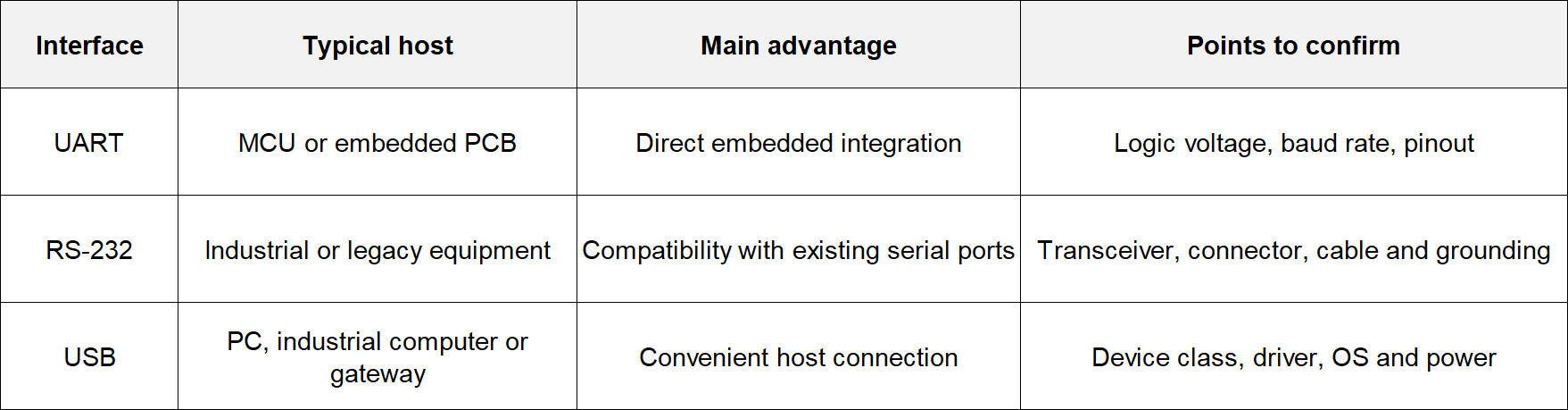
Choose UART when the GNSS module connects directly to a microcontroller or processor inside the same product.
Choose RS-232 when the target equipment already uses an RS-232 port or when an industrial external receiver is required.
Choose USB when the main host is a computer or gateway and confirmed USB firmware and driver support are available.
For an enclosed external receiver, begin with the host interface, cable length, connector, mounting position and environmental requirements. The enclosure format alone does not determine the correct electrical interface.
B2B buyers should provide the following information when requesting a GNSS sample:
- Application and host equipment
- Required GNSS systems and frequency bands
- Required interface
- Host logic voltage or port standard
- Data format and baud rate
- Position update rate
- Cable length
- Connector and pin definition
- Power input
- Enclosure and mounting requirements
- Operating environment
- Prototype and production quantities
These details reduce the risk of receiving a sample that has suitable positioning capabilities but cannot connect correctly to the target system.
WEILA provides board-level GNSS modules and enclosed receiver configurations for different integration requirements.
For example, the enclosed receiver configuration based on WKG035BT04Y01 uses standard NMEA 0183 data through TTL UART at the module level, with the external interface, cable and connector to be confirmed for each customer project.
Interface availability must always be verified for the selected model. Customers should provide their host port, pin definition, cable requirements and operating environment before sampling.
Explore the WEILA GNSS product range or contact WEILA with your complete integration requirements.
Can a UART GNSS module connect directly to an RS-232 port?
No. Logic-level UART and RS-232 use different electrical signalling. A suitable transceiver is normally required.
Is USB always the easiest GNSS interface?
No. USB may be convenient for computers, but an embedded MCU design may be simpler with UART.
Does RS-232 improve positioning accuracy?
No. RS-232 changes how data is transferred; it does not change the positioning calculations of the GNSS receiver.
Which interface is usually suitable for a microcontroller?
UART is commonly used, provided the voltage level, baud rate and pin definition are compatible.
Can one GNSS receiver provide several interface options?
This depends on its hardware and firmware. Each required interface must be confirmed for the specific product configuration.
Company Address
Floor 11, Block A, Building 9, Baoneng Science and Technology Park, Qingxiang Road, Longhua District, Shenzhen
Tel: +86 755-8329018
Business Hours
Monday–Friday
9:00 AM–6:00 PM (GMT+8)



+8613247518427



0755-8329018

13602688458

 Previous
 List
List