

 112
112
 0
0
Adding Wi-Fi, Bluetooth or GNSS capability to an IoT product involves more than selecting a communication standard. The development team must also decide where the wireless function sits within the complete product architecture.
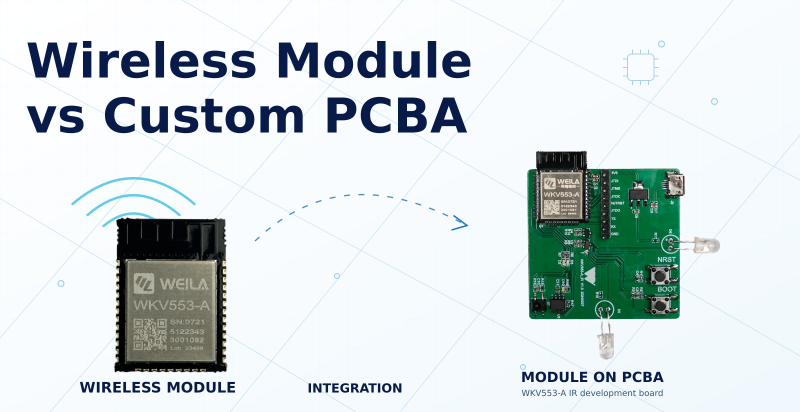
Should the product use a ready-to-integrate wireless module? Should the team develop a complete custom PCBA? Or should it combine a wireless module with an application-specific control board?
There is no single answer for every project. The appropriate route depends on the required functions, enclosure, engineering resources, target volume, compliance plan and level of product differentiation.
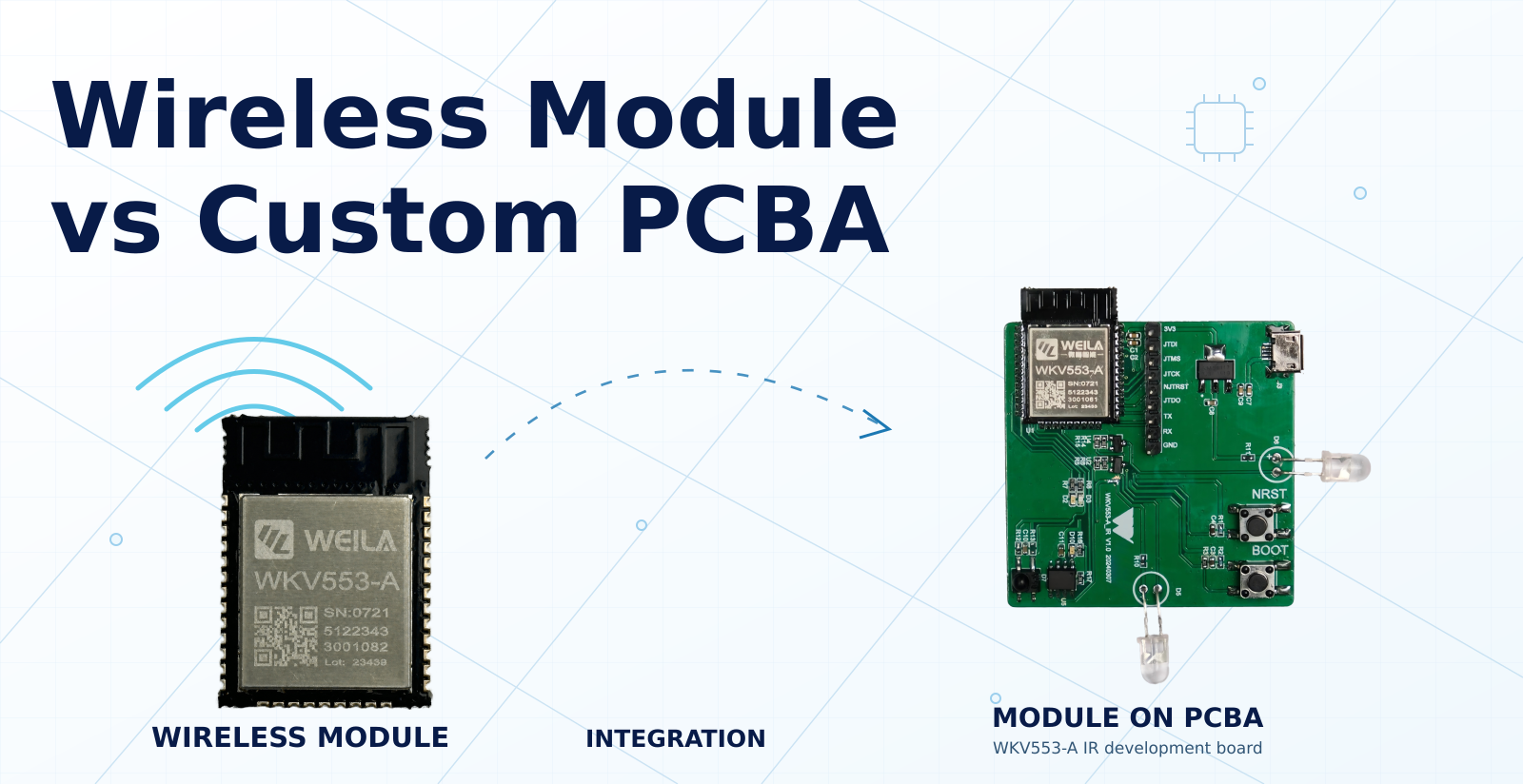
A wireless module integrates core communication functions into a compact component. Depending on the model, it may include the radio, processor, clock circuits, memory and supporting components needed for Wi-Fi, Bluetooth or GNSS operation.
The product manufacturer then integrates the selected module into a host board or control system.
A module-first project still requires engineering work. The team must confirm:
- Supply voltage and power behavior
- Host communication interface
- Antenna type and placement
- Firmware and protocol requirements
- Mechanical clearance
- RF environment
- Final-product testing
- Applicable regulatory requirements
Using a module can reduce the amount of RF and low-level hardware development required, but it does not eliminate system integration or finished-product validation.
A custom PCBA is an application-specific circuit board assembly developed around the complete product requirements.
It may combine:
- A host MCU or processor
- Power management
- Sensors
- Motor or relay control
- Display and button interfaces
- Audio circuits
- Wired communication
- Wi-Fi, Bluetooth or GNSS connectivity
- Product-specific connectors and protection circuits
Importantly, a custom PCBA does not always require a chip-down wireless design. A wireless module can still be mounted on a custom control board.
This hybrid architecture allows the product team to keep a pre-integrated wireless subsystem while customizing the power, control, sensor and interface sections of the product.
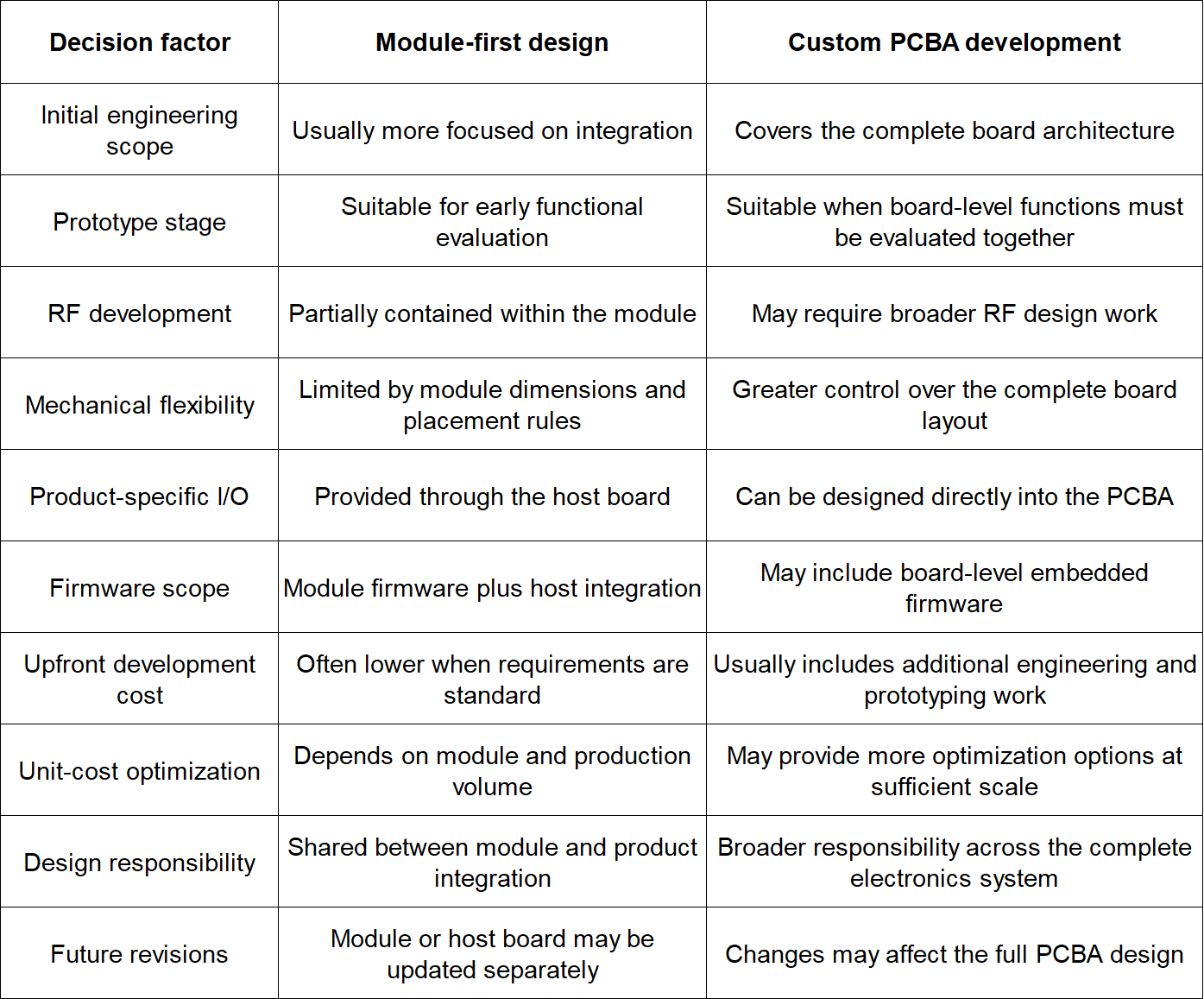
This matrix is a starting point rather than a universal rule. Actual cost and schedule must be evaluated against the project’s confirmed requirements.
A module-first approach is often worth evaluating when:
If the product needs a defined Wi-Fi, Bluetooth or GNSS function and does not require unusual RF architecture, an existing module may provide an efficient integration path.
The team must still confirm that the module supports the required interfaces, protocols, operating modes and firmware functions.
When an existing MCU or processor manages the main application, a wireless module can act as a communication subsystem.
Before selection, engineers should define which functions belong to the host and which functions belong to the module.
For an early-stage product or uncertain production volume, limiting initial engineering scope may be more important than reaching the lowest possible component cost.
A module can support prototype development while the team validates the application, data flow and user experience.
A common module can sometimes be integrated into several related products, while each host board provides different sensors, connectors or control functions.
Compatibility still needs to be confirmed for every board and enclosure.
A module does not remove the need for antenna and EMC evaluation, but it can reduce the amount of radio-level design that the product team must undertake internally.
Custom PCBA development becomes more relevant when the complete electronics architecture must be optimized around the product.
A custom board can combine wireless communication, power conversion, sensing, motor control, display interfaces and other product functions on one assembly.
This may reduce separate boards and connectors, but the design must be verified through prototyping and testing.
Wearables, compact appliances and embedded control products may have fixed board outlines, connector positions or enclosure restrictions.
A custom PCBA provides more control over the board shape and component placement. However, antenna clearance and RF performance must remain part of the mechanical design.
Non-standard sensors, motor drivers, audio functions, industrial interfaces or product-specific connectors may justify an application-specific board.
The requirement document should define electrical levels, timing, data direction, connector type and protection needs.
A custom board should not be selected only because its theoretical component BOM appears lower.
The decision should also account for development charges, prototypes, firmware, testing, production fixtures, compliance work, yield management and future maintenance.
A custom PCBA may simplify system control when one firmware architecture manages connectivity, peripherals and product logic.
Before development begins, the customer and supplier should agree on firmware ownership, source-code delivery, update responsibility, test criteria and long-term maintenance.
For many IoT products, the real decision is not ''module or custom PCBA''. It is whether to place a wireless module on a custom application board.
In this architecture:
- The wireless module provides the selected communication platform
- The custom PCBA handles power, sensors, actuators and product-specific I/O
- Firmware defines how the wireless and application sections work together
- The finished device is validated as one complete system
This approach can balance integration flexibility with a more contained wireless subsystem.
The exact division of functions should be defined before schematic design. Otherwise, the project may duplicate processing resources, overlook interface limitations or create unnecessary firmware complexity.
Procurement teams often compare the price of a module with the component cost of a custom board. This is incomplete.
A realistic comparison should include:
- Engineering and non-recurring development cost
- PCB layout and prototype revisions
- Antenna and enclosure validation
- Embedded firmware development
- Application or cloud integration
- Compliance and regulatory testing
- Production test fixtures
- Assembly yield and rework
- Component sourcing and lifecycle management
- Firmware updates and after-sales maintenance
A lower component price does not automatically produce a lower total project cost. The correct comparison is the complete cost of reaching a stable, manufacturable and supportable product.
Before requesting a module recommendation or custom PCBA quotation, prepare the following information:
1. Product application
What equipment is being developed, and who will use it?
2. Required wireless functions
Is the project using Wi-Fi, Bluetooth, GNSS or a combination?
3. System architecture
Is there already a host MCU, or must the wireless platform also run application logic?
4. Data flow
What data is collected, processed, transmitted or stored?
5. Interfaces and peripherals
List required UART, USB, GPIO, I²C, SPI, ADC, PWM or other connections.
6. Power conditions
Define input voltage, operating mode, battery requirements and expected duty cycle.
7. Mechanical limits
Provide board dimensions, enclosure drawings, antenna restrictions and connector positions.
8. Firmware scope
Clarify provisioning, communication protocols, control logic, update requirements and host responsibilities.
9. Target markets
Identify sales regions so that applicable compliance requirements can be reviewed.
10. Expected project volume
Provide prototype quantity, forecast volume and expected production stages.
11. Testing requirements
Define functional, RF, environmental and production-test expectations.
12. Commercial responsibilities
Confirm ownership of design files, firmware, test tools and future revisions.
Providing this information helps engineering and procurement compare architectures on the same basis.
WEILA's published service scope includes wireless module supply, hardware design, firmware development, PCBA development and technical support. Its public engineering workflow covers requirement review, hardware design, firmware, prototype testing and mass production. weila-tech.com
WEILA also publicly lists IoT and PCBA solution categories including smart kitchen appliances, pet feeders, air-purifier control boards, gas detection and Wi-Fi IR gateways. These pages are solution references rather than claims that one standard design fits every project. Embedded Electronics Development - WEILA
For a new project, send WEILA the application, connectivity requirements, board dimensions, interfaces, power conditions, firmware scope, target market and estimated volume.
The engineering team can then evaluate whether the project should use:
- A standard wireless module
- A wireless module with a customer-designed host board
- A module integrated into a WEILA-developed PCBA
- A more extensively customized hardware and firmware architecture
The final solution, development scope, commercial terms and test requirements should be confirmed for the individual project.
Choosing between a wireless module and custom PCBA is an architecture decision, not simply a component-price comparison.
A module-first approach may suit projects with standard connectivity, an existing host and a need to limit initial development scope. A custom PCBA may be justified when the product requires tighter mechanical integration, specialized peripherals or consolidated control functions.
For many IoT products, a custom application board using a wireless module provides a practical middle path.
Define the complete product requirements first. Then compare engineering responsibility, integration risk, total project cost and production scale before selecting the hardware route.
Company Address
Floor 11, Block A, Building 9, Baoneng Science and Technology Park, Qingxiang Road, Longhua District, Shenzhen
Tel: +86 755-8329018
Business Hours
Monday–Friday
9:00 AM–6:00 PM (GMT+8)



+8613247518427



0755-8329018

13602688458

 Previous
 List
List