

 178
178
 0
0
RTK GNSS Module Integration Guide for OEM Devices
An RTK GNSS module needs a working correction-data link and a correctly configured host connection to support high-precision positioning. For an OEM device, these requirements should be defined before the PCB, firmware and enclosure are finalized.
This guide explains the correction input, positioning output and validation steps to confirm before requesting a module sample.
Choose the correction source
RTK uses satellite observations together with compatible reference-station data. A project may obtain this data from a local base station or a CORS network. The choice depends on the installation area, available infrastructure and communication arrangement.
Confirm coverage, the required correction format and message types, and how the device will obtain the stream. For a local base station, also confirm the reference coordinates and the link to the rover device. For a network service, confirm access credentials and the selected stream or mountpoint.
Receiver and service compatibility should be checked using the intended firmware and correction stream. A general statement of RTCM support does not establish compatibility with every service configuration.
Deliver RTCM data to the module
RTCM defines correction-data formats. NTRIP provides a way to stream GNSS data over the Internet. In a typical network arrangement, an NTRIP client obtains the corrections and forwards them to the receiver through a compatible input interface.
Decide which part of the product handles the network connection and NTRIP client. Depending on the design, this may be the host controller, a gateway or another connected device. Some services also require the client to send the rover position, often using a GGA message; follow the selected provider requirements.
The host should forward the received RTCM bytes without converting them into text or removing binary values. During evaluation, check message reception, correction age where available, and recovery after a communication interruption. Confirm the acceptable latency for the selected receiver and service.
Connect the host and interpret the output
The host normally handles two data directions: correction input to the GNSS module and positioning output from it. These functions need a consistent interface configuration.
Data | Direction | Purpose |
RTCM corrections | Host to module | Provide compatible reference data |
NMEA positioning data | Module to host | Report position and supported navigation information |
Confirm supply voltage, serial logic levels, pin definitions, baud rate and the enabled messages. Logic-level UART and RS-232 require different electrical signalling; select the appropriate interface circuitry. A USB connection also needs suitable interface hardware and software support.
The application should evaluate positioning quality as well as latitude and longitude. RTK float and RTK fixed represent different solution states. Confirm how the exact receiver firmware reports those states before writing the parser. The presence of an NMEA sentence alone does not prove a fixed RTK solution.
Validate operation in the finished device
Evaluate the complete prototype using the intended antenna, enclosure, power supply, host firmware and correction link. Placement near metal, displays, switching circuits or other transmitters can affect reception. Test with the other device functions operating.
Define acceptance criteria for the intended use and record the following during testing:
Position error against a suitable reference under documented conditions
Time to reach a usable solution and the proportion of time in the required solution state
Correction reception, interruptions and reconnection behaviour
Performance in the planned stationary or moving operation
Host behaviour when positioning quality decreases or data becomes stale
These checks establish whether the finished equipment meets the project requirements. A successful position fix on an open evaluation board is only an early integration result.
WEILA WKG035BT0FY01 integration example
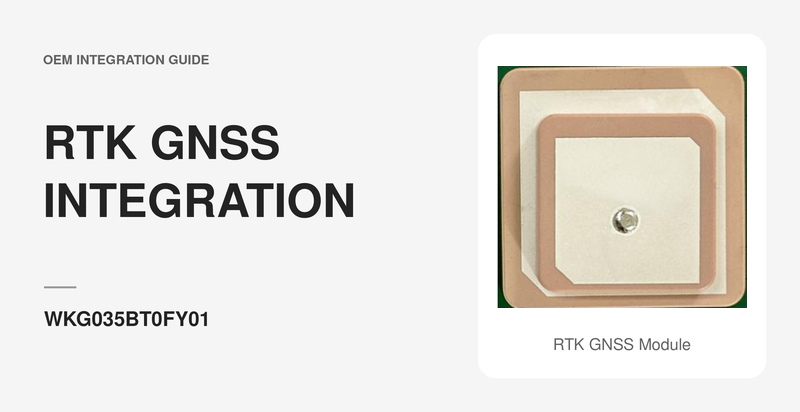
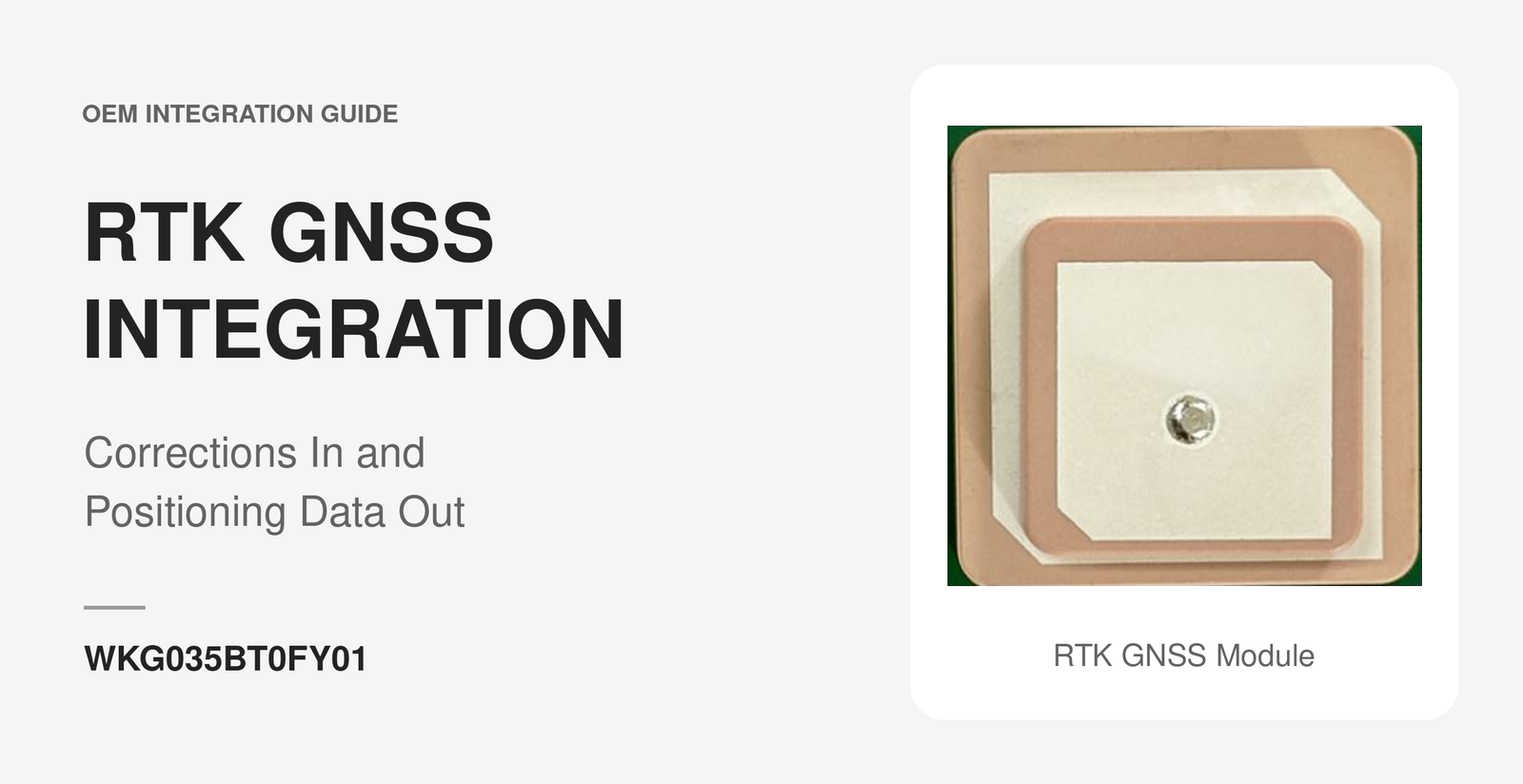
WEILA WKG035BT0FY01 is a 35 × 35 × 13 mm dual-frequency, multi-constellation RTK GNSS module based on ATGM332D-F8P. Its documented features include RTCM 3.x support, NMEA-0183 positioning output and a default communication rate of 115200 bps.
Centimeter-level RTK positioning requires a compatible base station or CORS network. For a project evaluation, confirm the correction source, required RTCM messages, host interface and installation conditions with the WEILA team. Validate the intended configuration before approving the design.
Frequently asked questions
Can an RTK module provide centimeter-level positioning without corrections
For the RTK operation described here, compatible reference data is required. Standalone GNSS operation should be evaluated against the receiver specifications for that mode.
Are RTCM and NTRIP the same thing
No. RTCM describes correction-data formats, while NTRIP transports GNSS data over the Internet.
Does RTCM support mean a module includes cellular connectivity
No. The communication hardware and the client that obtains the correction stream must be confirmed separately.
Can the host use every received coordinate as a high-precision position
The host should check the reported solution quality and data freshness. Confirm the quality indicators for the exact firmware and define the application response when quality changes.
Planning an RTK-enabled product? Share your application, correction source, host interface, installation environment and target positioning requirements with WEILA to discuss module integration.
Company Address
Floor 11, Block A, Building 9, Baoneng Science and Technology Park, Qingxiang Road, Longhua District, Shenzhen
Tel: +86 755-8329018
Business Hours
Monday–Friday
9:00 AM–6:00 PM (GMT+8)



+8613247518427



0755-8329018

13602688458

 Previous
 List
List