

 264
 0
A sensor controller sends a reading through a Bluetooth Low Energy module. The receiving application gets data, but occasionally displays an incomplete value or combines two readings incorrectly.
Before changing the hardware, examine how the application identifies a complete message.
For UART-over-BLE integration, define the application message separately from the chunks used to transport it. Then test whether the receiver can reconstruct and validate that message.
A UART-to-BLE bridge transfers data between a serial interface and a Bluetooth connection. A documented example is Nordic UART Service, which uses a custom GATT service to bridge UART data through write and notification characteristics. This is one implementation, rather than a universal service definition for every BLE module.nRF Connect SDK 3.4.99 documentation
For a specific module, check its firmware documentation. Confirm the service definitions, supported transfer direction, UART settings and buffering behavior.
"Transparent transmission" alone does not define the meaning of a temperature reading, the end of a command or the response expected by your application.
A standard ATT Handle Value Notification carries up to ATT_MTU minus three bytes of attribute value. The usable transfer size must therefore be checked against the connection and implementation. A larger application message needs an explicitly supported transfer strategy; it should not simply be assumed to fit in one notification.bluetooth.com
The engineering implication is straightforward: do not assume that one MCU write will always appear as one complete application record.
Check how the selected firmware packages serial data and how the receiving software presents it. Build the parser around the agreed message format.
For an initial integration test, a text record can be easy to inspect:
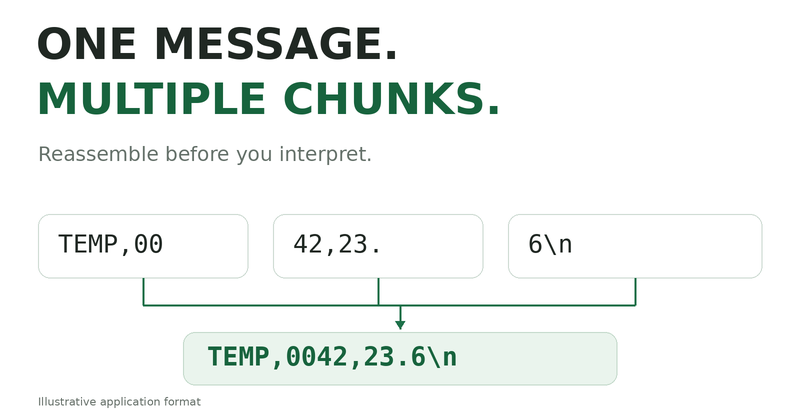
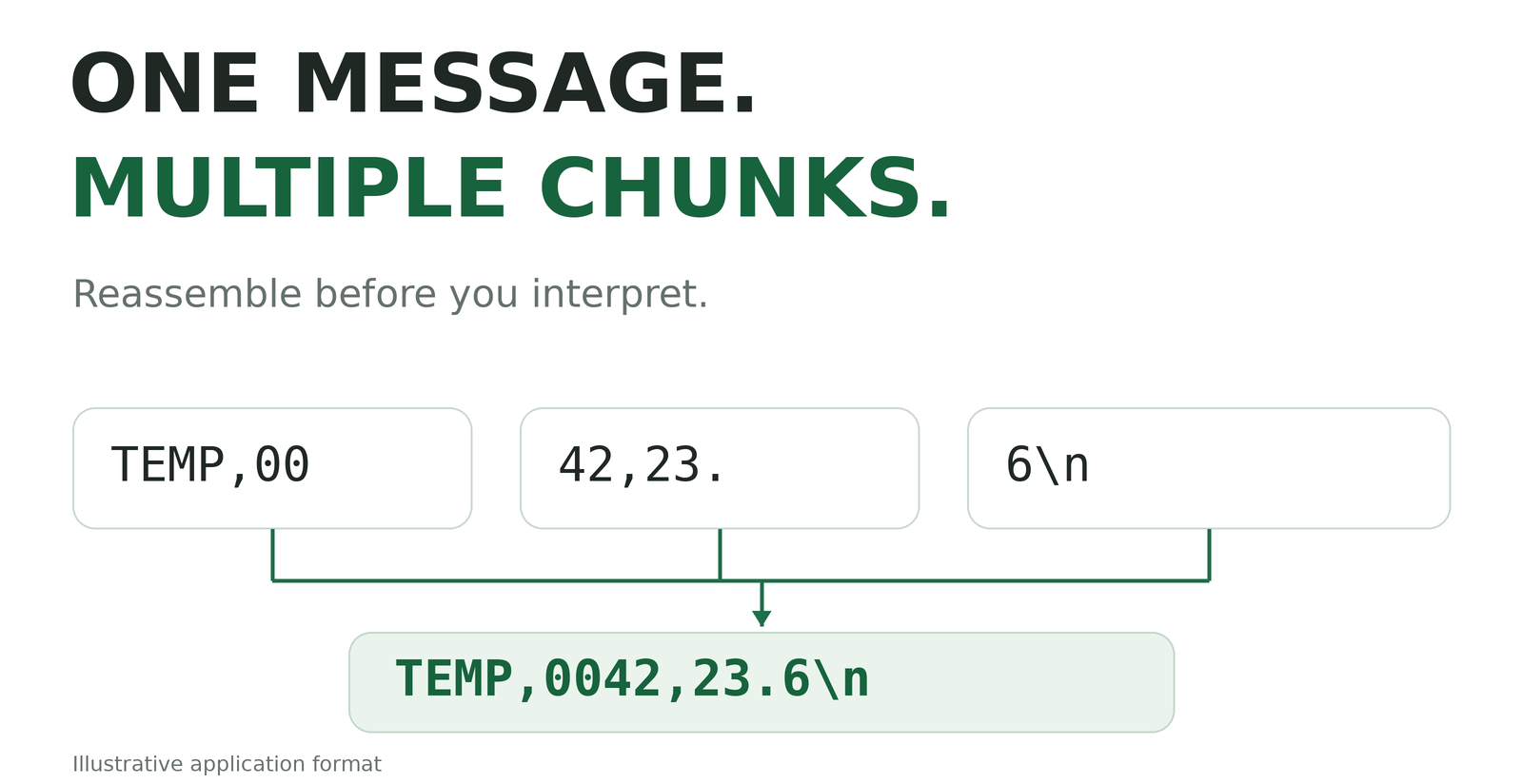
TEMP,0042,23.6\n
In this illustrative format:
- TEMP identifies the message type.
- 0042 is a sequence number.
- 23.6 is the measurement.
- \n terminates the record.
This is a proposed application format, not a WEILA module command.
The receiving parser should accumulate incoming bytes until it finds the terminator. It should then validate the fields and retain any remaining bytes for the next record.
Specify the character encoding, units, maximum record length and handling of invalid fields. If a field can contain the delimiter, define an escaping rule or choose another framing method.
For binary data, consider a format with a recognizable header, message type, payload length and payload. Add an integrity check where the application requires one, with its algorithm and coverage defined precisely.
Do not validate only with a single short reading.
Feed the example record to the parser in separate pieces:
TEMP,00
42,23.
6\n
The expected result is one validated reading after the final piece arrives.
Next, provide two records together:
TEMP,0042,23.6\nTEMP,0043,23.7\n
The expected result is two readings.
These are synthetic parser tests. They illustrate the behavior your software should handle; they are not measured results from a WEILA product.
Also test an incomplete record, an invalid field, a missing terminator and a record longer than the permitted maximum. Define a bounded buffer and a recovery rule so malformed input cannot consume memory indefinitely.
For control applications, distinguish receiving bytes from successfully applying a command.
A proposed application protocol might identify each command and return a matching result containing success, rejection or an error reason. Define the timeout and retry rules before testing.
Consider what happens if a command succeeds but its response is not received. Retrying a ''set value'' command and retrying an ''increment value'' command may have different consequences. Decide how the application will detect or safely handle duplicates.
After disconnection, specify whether incomplete records are discarded and whether pending commands must be reconciled before normal operation resumes.
WEILA's WKB5010 product page lists BLE connectivity and UART interfaces. Those hardware specifications provide a starting point for evaluation, but do not establish a particular transparent-transmission packet format, buffer capacity or application acknowledgment mechanism.weila-tech.com
For a WEILA BLE module evaluation, prepare a sample message, its maximum length, normal reporting frequency, expected bursts and target host devices. Ask for the documentation corresponding to the firmware being evaluated.
Customer application software must implement the agreed data format. Any firmware adaptation or additional development should be confirmed for the specific project.
A useful acceptance test demonstrates that complete application messages are reconstructed correctly—including during bursts, invalid input and reconnection—under documented test conditions.
FAQ
Does BLE transparent transmission define my sensor data format?
No. Define the field meanings, units, message boundaries and validation rules in the application protocol.
Should one UART write equal one BLE notification?
Do not assume this relationship. Check the module firmware's packaging behavior and test the receiving parser with split and consecutive records.
Does a higher UART baud rate guarantee faster application delivery?
No. UART speed is only one part of the transfer path. Evaluate the complete system with representative message sizes and traffic patterns.
Does WKB5010 automatically provide message reassembly and command acknowledgments?
These behaviors must be checked against the specific firmware documentation. Do not infer them from the module's BLE and UART hardware capabilities.
What should I prepare for a module evaluation?
Provide example messages, maximum message length, reporting and burst requirements, target hosts and expected behavior after disconnection.
Company Address
Floor 11, Block A, Building 9, Baoneng Science and Technology Park, Qingxiang Road, Longhua District, Shenzhen
Tel: +86 755-8329018
Business Hours
Monday–Friday
9:00 AM–6:00 PM (GMT+8)



+8613247518427



0755-8329018

13602688458

 Previous
 List