

 233
233
 0
0
Smart appliances need a simple setup process and a reliable connection to online services.
Wi-Fi and Bluetooth Low Energy can serve different roles within the same product. Bluetooth Low Energy can simplify initial device provisioning, while Wi-Fi provides the internet connection required for cloud communication, remote functions and online AI services.
By integrating Wi-Fi and BLE into one module, manufacturers can build a more practical wireless architecture for smart appliances and other connected IoT products.
Before a smart appliance can connect to the internet, it must receive the correct Wi-Fi network name and password.
This can be difficult for products without a display, keyboard or other convenient input interface. Examples include:
- Kitchen appliances
- Smart lighting devices
- Environmental controllers
- Pet-care products
- Small household appliances
- IoT control panels
Bluetooth Low Energy provides a convenient short-range connection between the appliance and a mobile application during this setup process.
In WEILA's current smart-appliance connectivity architecture, BLE is used for device provisioning.
The connection process works as follows:
- The appliance enters provisioning mode.
- The mobile application discovers the appliance through BLE.
- The user selects the required Wi-Fi network.
- The application transfers the Wi-Fi network information to the appliance through BLE.
- The wireless module connects to the router through Wi-Fi.
- Wi-Fi becomes the main channel for internet and cloud communication.
BLE therefore helps the appliance obtain the information it needs to access the network.
It does not replace Wi-Fi. Its confirmed role in this solution is to simplify the initial provisioning process.
After provisioning is completed, Wi-Fi connects the appliance to the router and online services.
Depending on the complete product architecture, Wi-Fi may support:
- Cloud data exchange
- Remote device control
- Operating-status reporting
- Alarm and maintenance notifications
- Firmware updates
- Mobile application services
- Cloud-based AI voice control
Wi-Fi provides the longer-term network connection, while BLE supports the initial setup.
This division of functions creates a clear user flow:
Mobile App → BLE Provisioning → Wi-Fi Connection → Cloud Service
Bluetooth provisioning should not be confused with local AI processing.
BLE transfers the Wi-Fi network information from the mobile application to the appliance. It does not perform speech recognition or understand voice commands.
In a cloud-based AI voice-control solution, voice data must still be transmitted to an online AI service through Wi-Fi. The cloud service performs speech recognition and command processing before returning the result to the device.
Therefore:
- BLE is used for provisioning.
- Wi-Fi is used for cloud communication.
- BLE does not provide local voice recognition.
- The current AI voice function requires an internet connection.
- Offline voice control is not currently supported.
This distinction is important when evaluating a Wi-Fi + BLE module for a smart-appliance project.
Using one module that integrates both wireless technologies can simplify product development.
A combined module can reduce the need to integrate separate Wi-Fi and Bluetooth devices.
This may simplify:
- Component selection
- PCB layout
- Firmware coordination
- Wireless testing
- Procurement and production management
BLE allows a mobile application to discover the appliance at short range and transfer the required Wi-Fi information.
The user does not need to enter the network information directly on the appliance.
After setup, Wi-Fi provides the connection required for cloud services, remote functions and online AI processing.
The same module platform can be used across different smart-appliance projects, although the firmware, application and cloud functions must still be developed according to the specific requirements of each product.
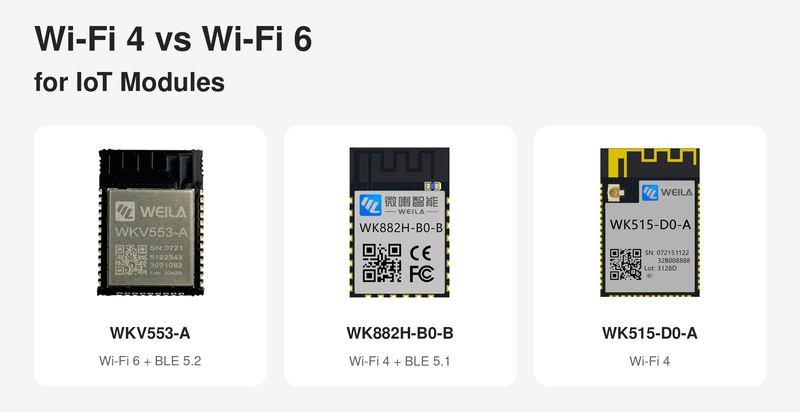
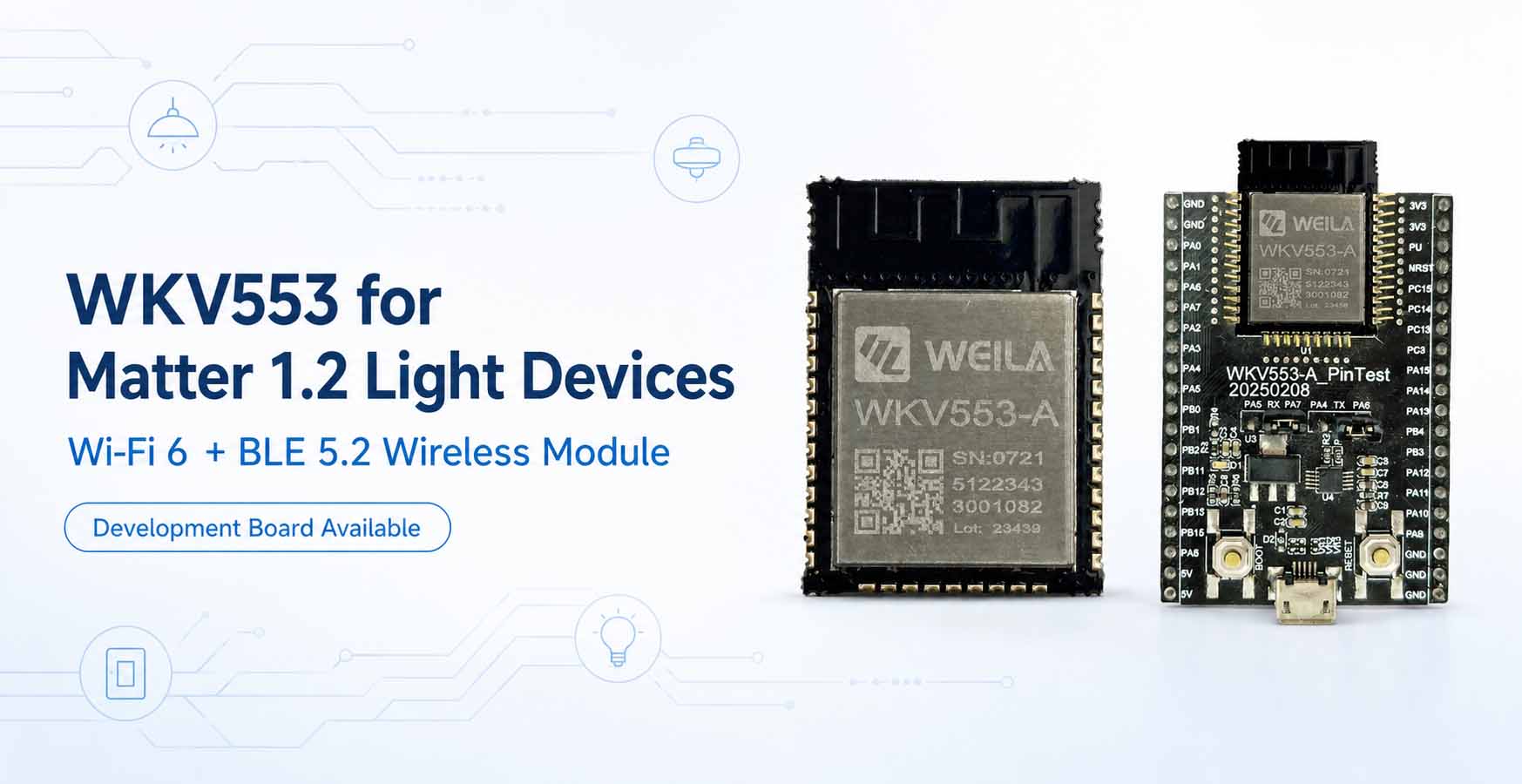
The WEILA WKV553-A is a compact wireless module that integrates:
- 2.4 GHz Wi-Fi 6
- Bluetooth Low Energy 5.2
- A 32-bit RISC-V processor
- ADC
- SPI and QSPI
- I²C
- USART and UART interfaces
Its module size is 18 × 20 mm.
WKV553-A can be used as the wireless foundation for smart appliances, IoT devices, consumer electronics, communication gateways and customized PCBA projects.
The final functions depend on the firmware, mobile application, cloud platform, host controller and complete product architecture.
In WEILA's current cloud-based AI voice-control solution for kitchen appliances, WKV553-A supports both the provisioning process and cloud connection.
The operating flow is:
- The mobile application discovers the appliance through BLE.
- The application transfers the Wi-Fi network information through BLE.
- WKV553-A connects to the router through Wi-Fi.
- The microphone captures the user's voice.
- Voice data is transmitted to the cloud AI service through Wi-Fi.
- The cloud service performs speech recognition and command processing.
- The result is returned to WKV553-A.
- WKV553-A communicates with the appliance controller.
- The appliance performs the requested action.
In this solution, BLE makes the initial setup easier, while Wi-Fi connects the appliance to the cloud AI service.
Because speech recognition is performed in the cloud, the current voice-control function is unavailable when the device cannot access the internet.
Before selecting a Wi-Fi + BLE module, manufacturers should confirm:
- The appliance type and required functions
- The mobile application requirements
- The BLE provisioning process
- The required cloud platform
- The host controller and communication interfaces
- The antenna option and enclosure environment
- The target countries or markets
- Whether voice processing is local or cloud-based
- Expected behavior when the network is unavailable
- Prototype and production quantities
Providing this information allows the engineering team to evaluate the module, firmware and PCBA requirements as one complete system.
Wi-Fi and Bluetooth Low Energy have different but complementary roles in smart appliances.
BLE simplifies the initial provisioning process by transferring Wi-Fi network information from the mobile application to the appliance. Wi-Fi then connects the appliance to the router, cloud platform and online AI services.
The WEILA WKV553-A combines Wi-Fi 6 and BLE 5.2 in one compact module, providing a practical wireless foundation for smart appliances and customized IoT products.
In WEILA's current AI voice-control solution, BLE is used for provisioning and Wi-Fi is used for cloud communication. The voice function depends on the internet and cloud AI service, and offline voice recognition is not currently supported.

Bluetooth provisioning uses BLE to transfer Wi-Fi network information from a mobile application to an appliance during initial setup.
No. BLE supports the provisioning process. Wi-Fi connects the appliance to the router and internet.
No. WEILA's current AI voice-control solution uses a cloud-based voice service and requires Wi-Fi internet access.
No. BLE is a wireless communication technology. It does not perform local speech recognition or command processing.
WKV553-A integrates 2.4 GHz Wi-Fi 6, BLE 5.2, a 32-bit RISC-V processor and multiple interfaces for wireless and IoT product development.
It is the core wireless module. The finished solution also requires suitable firmware, a mobile application, cloud services, control logic and product-specific hardware development.
- WKV553-A Wi-Fi 6 and BLE 5.2 module → WKV553-A
- wireless modules → WEILA Wireless Modules
- IoT and PCBA development → WEILA IoT Solution & PCBA
- contact WEILA → WEILA Contact
Company Address
Floor 11, Block A, Building 9, Baoneng Science and Technology Park, Qingxiang Road, Longhua District, Shenzhen
Tel: +86 755-8329018
Business Hours
Monday–Friday
9:00 AM–6:00 PM (GMT+8)



+8613247518427



0755-8329018

13602688458

 Previous
 List
List