

 141
 0
A GNSS receiver can provide time information as well as position. For an embedded clock, however, reading a time field is only one part of the design.
Before selecting a module, define how the host will obtain the date and time, identify the second boundary, and respond when satellite timing becomes unavailable. These requirements help distinguish a basic clock display from a system that needs controlled synchronization.
Write the requirement at the point where time is actually used: the display, event logger, sampling circuit or host clock.
For example, ''show the current UTC time'' and ''align measurements from two devices'' require different evaluation methods.
Specify the permitted error, operating environment and acceptable startup behavior. Also state what should happen during an interruption. Avoid selecting a receiver solely because its product description mentions timing.
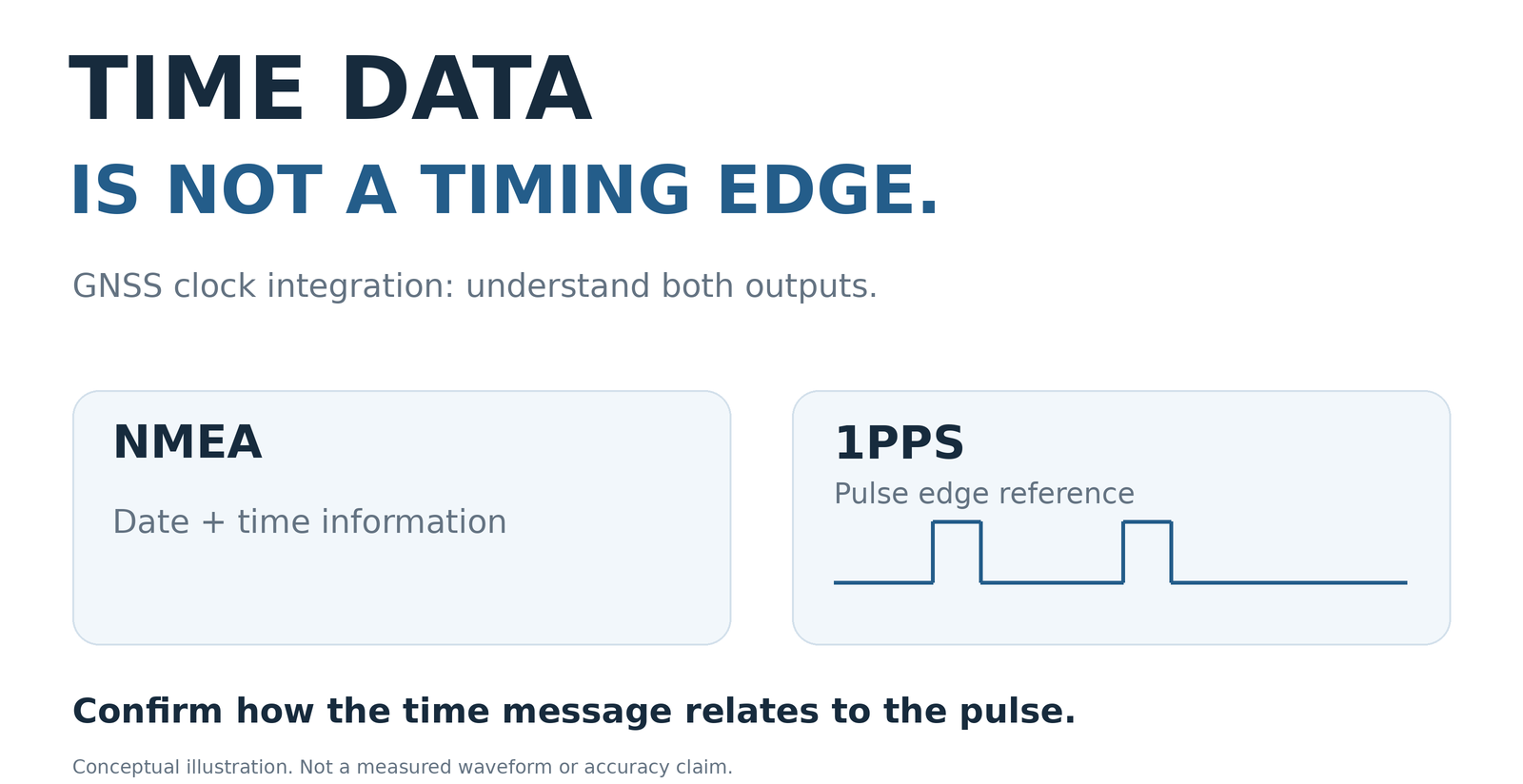
A serial message carries information, including time fields where supported. A 1PPS output provides one pulse per second; the specified edge can serve as a timing reference.
The arrival of serial data at the host should not automatically be treated as the exact second boundary. Receiver processing, serial transmission and host handling introduce delays.
A pulse alone also does not identify the calendar date or tell the application which second it represents. The design must associate the pulse with the correct time information using the selected receiver’s documentation.
Confirm that relationship before writing synchronization logic. Do not assume every receiver uses the same message-to-pulse sequence. content.u-blox.com
Check whether the selected module exposes the required timing output on an accessible pin.
Then confirm:
- Output voltage and electrical compatibility.
- Reference edge and pulse width.
- Supported time reference and configuration.
- Behavior before valid timing is available.
- Available timing-status information.
- Settings retained after a power cycle.
A PPS label does not establish an accuracy guarantee. Likewise, a positioning specification does not define timing performance.
Timing-output configuration and behavior depend on the product variant. Use the documentation for the exact ordering code and firmware rather than transferring specifications from a related receiver. content.u-blox.com
The receiver output is only one point in the complete timing path.
Review how the host captures the pulse and updates its clock. Where the application requires precise edge measurement, evaluate a hardware timer capture path and account for the delays introduced by the chosen implementation.
The antenna installation and signal path also matter. Cable delay, receiver delay and reception conditions can affect timing measurements.
For an absolute-accuracy requirement, compare the assembled system against a suitable reference. Record the measurement point, configuration and operating conditions. A module specification should not be presented as a measured result for the finished device. content.u-blox.com
Include interruption tests in the evaluation plan.
Observe the system during startup, reduced reception, loss of satellite signals and recovery. Check both the output signal and the status reported to the application.
Define whether the host should continue on its local clock, mark timestamps as unsynchronized, or stop a timing-dependent operation.
Holdover requires a defined local-clock strategy. A receiver continuing to produce a pulse does not, by itself, prove that the output remains synchronized to UTC. Dedicated timing products may include specific holdover functions; confirm availability and limits for the selected hardware. u-blox
When discussing a GNSS timing requirement with WEILA, provide:
- The device type and intended timing function.
- The required accuracy and measurement point.
- The host interface and pulse-input requirements.
- The antenna location and operating environment.
- The required startup and interruption behavior.
- The proposed acceptance test.
Ask for confirmation of the suitable model, firmware, pinout and documented timing characteristics before committing the design.
A useful evaluation establishes what the complete device must do—and then checks whether the selected receiver and host implementation can meet that requirement.
FAQ
Can I synchronize a clock using NMEA messages alone?
You can use supported time fields to update a clock. Whether that meets your accuracy requirement depends on the complete receive and processing path.
Does every WEILA GNSS module provide 1PPS?
Confirm the exact model, pinout and firmware. Do not assume that every module or connector exposes a usable timing output.
Does centimeter-level positioning mean better clock accuracy?
It does not establish a timing guarantee. Positioning and timing requirements need their own specifications and validation.
What should I request for a satellite-clock project?
Request model-specific timing documentation, electrical details, validity behavior and an agreed test method.
Company Address
Floor 11, Block A, Building 9, Baoneng Science and Technology Park, Qingxiang Road, Longhua District, Shenzhen
Tel: +86 755-8329018
Business Hours
Monday–Friday
9:00 AM–6:00 PM (GMT+8)



+8613247518427



0755-8329018

13602688458

 Previous
 List